Showing posts with label books. Show all posts

February 06, 2020

Clay Carey's book noted in Nicholas Lemann's 'Can Journalism Be Saved?' piece in NYR

The Feb. 27 issue of the New York Review of Books has a feature article by Nicholas Lemann, "Can Journalism be Saved?", that cites 14 books, including The News Untold: Community Journalism and the Failure to Confront Poverty in Appalachia, by our esteemed colleague, Michael Clay Carey. Here's what the dean emeritus of the journalism faculty at the Columbia University Graduate School of Journalism had to say about Clay's work:

"Michael Clay Carey’s The News Untold, an ethnographic study of journalism in three small rural Appalachian communities, offers the hope that such papers could draw badly needed attention to poverty. His own careful research demonstrates how pathetically under-resourced these papers are. Carey interviews the owner of one of his small-town papers in the barbershop where he cuts hair three days a week, because the paper can’t support him full time; the paper’s editorial staff, consisting of one person who was hired through a temporary employment agency, is also part-time. Carey’s call for the papers to become less boosterish and more “inclusive” in their coverage is affecting, but with what resources would they undertake this? It would be possible to ask poor people to tell their own stories in such papers, but that wouldn’t be much different from starting a group conversation online. As [Michael] Schudson asks [in Why Journalism Still Matters], “What news items have the president or the Congress, governors or mayors, or corporate executives been forced by law or public opinion to respond to?” Outside of work produced by news organizations, “Little or none, I suspect.” In poor small towns, far more than in Washington, such reporting requires subsidy."

And there's no one to subsidize it. Not the audience, which is penurious, aging and migrating out. Not the advertisers, who have been savaged by big-box stores, Amazon and the internet, and are disappearing. Not the philanthropies, who have never really understood rural America and sure as heck don't understand rural journalism. If that sounds like a gripe from someone who has failed to raise much money from them, it is, but it's also an admission of failure to educate them. Now they and rural America will learn the hard way; in the last three years, I have seen the finances of rural weeklies begin to take the same sort of hits from ad losses that their metro cousins took a decade ago. More than ever, they must make themselves essential servants to their communities, and make sure those communities understand their value.

July 06, 2012

A request from Tommy Thomason

Got this note in from Tommy Thomason, professor at TCU's Schieffer Journalism School and director of the Texas Center for Community Journalism:

I’m looking to find some of America’s outstanding community journalists, and I thought my fellow COMJIG members might be able to help. 

I’m currently writing a book about investigative reporting in community journalism. Most folk see investigative reporting as the exclusive province of the dying metros, but some of the unsung heroes of journalism are doing great investigative pieces in small communities with limited staff, resources and budgets. These are the folk who work on their investigative stories until they have to take a break to go cover the county agent speaking to the Rotary club. 

I’m writing the book with Kathy Cruz, a reporter with a community paper in Texas who is herself one of the best investigative reporters in community journalism. It’s titled “You might want to carry a gun:  Community newspapers expose big problems in small towns.” And this is where I am hoping my COMJIG colleagues can help – we’re still on the lookout for more outstanding examples of community journalists who have done important investigative stories. 

We’re especially interested in those who have overcome some obstacles to complete their work – threats to their safety, community resistance to the story or series, advertiser resistance to the investigation, problems with their colleagues at the paper … you get the idea. We’re telling their stories, and to make the book more useful to journalists and students, we’re passing along the how-to’s that show the techniques behind the investigation.  

We’re not interested in papers that show courageous editorial leadership – this is a book highlighting reporting.  These reporters tend not to be well-known; only a few, like Samantha Swindler, end up having "60 Minutes" do a piece on them.  But that’s why we want to tell their stories and to share their techniques.  

If you know of a reporter or editor who might be a good profile for us, please let me know.  Just a name and a paper, and maybe a sentence about why you think this person should be in the book.  We’ll take it from there.  Email me at t.thomason@tcu.edu.

April 02, 2012

New book examines objectivity in the modern age

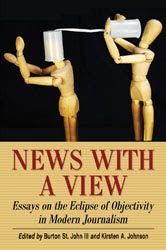
News With a View
Several scholars familiar to COMJIG (and CCJIG) members are among authors in a new collection, News with a View: Essays on the Eclipse of Objectivity in Modern Journalism. They include John Hatcher, Deborah Chung, Seungahn Nah and Wilson Lowrey.

The book, edited by Burton St. John III of Old Dominion University and Kirsten A. Johnson of Elizabethtown College, is published by North Carolina-based McFarland. Johnson is head of CCJIG.

According to McFarland's blurb on the book:

Modern mainstream journalism faces a very real disturbance of its foundational premise that credible news is gathered and articulated from an objective stance. This volume offers new examinations of how the traditional notion of objectivity is changing as professional journalists grapple with a rapidly evolving news terrain--one that has become increasingly crowded by those with no journalistic credentials. Examining historical antecedents, current dilemmas, international aspects, and theoretical considerations, contributors make the case that the journalist’s impulse to hold onto objectivity, and to ignore the increasing subjectivities to which citizens are attuned, actually contributes to the news media’s disconnect from today’s news consumer. Revealing how traditional journalism needs to incorporate "post-objective" stances, these essays stimulate further thought and conversation about news with a view in both theory and practice.


For more on News with a View, see www.mcfarlandpub.com.

March 19, 2008

New Convergent Journalism Book


Just a note that, finally, it's a book. "Principles of Convergent Journalism," co-written by Doug, Augie Grant and Jeff Wilkinson was released late last week from Oxford.

We've tried to build a book that can be used by newbies or professionals to bridge the gap to the "other" media by giving them the basics to work in all, and a killer glossary so that they can speak the lingo.

If you get an exam copy, let us know how you like it.

Doug

Update May 2008
Awhile back, Bill Reader asked me to expound a bit more on the community journalism connection in the book. As often happens, I got swamped with classes and seminars like ACES and got behind. But let me now correct that.

When we wrote the book, the journalist always in my mind's eye was at a small daily, 20,000 or less, or maybe a larger weekly or twice- or thrice-weekly. A place where some of my students have gone, like the Shelby (N.C.) Star, which has gone heavily into digital journalism -- audio, video, online maps, etc. One of its newest assets is the Star Car, a completely outfitted live unit:

Online wireless capabilities through a cell phone connection.
A camera mounted on it where people online can see what reporters see.
A GPS tracking system that lets people watch where the car is going online ... not only can you watch the news as it happens, you can watch the Star Car as it's chasing the news that's happening.
I also had in the back of my mind the journalist at the small community TV station, like many in the Midwest and Mountain West, who might now be called on to file "print" for the Web site (yes, we know much of it is still "shovelware," but that will change). And all three of us wanted to show that convergent journalism does not just mean the big three: print, broadcast and online. So our approach to the book was, first, to give some practical advice to those who suddenly are thrown into doing "another" medium. Thus we have chapters on the basics of broadcast for print folks and the basics of print for broadcast folks (I think the illustration of the same story - broadcast and print - that highlights the differences, especially the additional information needed for print and the need to think visually for broadcast is one of the best parts of the book).

We also then talk about "repurposing" print and broadcast for online. Some folks have not liked us for doing that, but we felt it was disingenuous not to acknowledge the current state of affairs and at least try to suggest some best practices.

We then have chapters devoted to new types of content online and -- and this is important -- other types that may emerge as well, such as billboards and radio sidebands.

Finally, the glossary is one of the most complete we know of that seeks to enable a journalist to translate from print to broadcast to digital technologies.

We know that journalists at small papers and broadcast stations already are multitasking -- for instance that small-newspaper reporter probably also is taking still photos. So while we talk about stills, the person might skip that (or he or she might pick up a pointer or two).

The book is aimed not only at students, but at professionals looking to "repurpose" themselves. More information and resources are on our wiki, and here is a chapter list:
  1. Introduction to Convergent Journalism (pg. 1)
  2. Basic Skills and Roles in Convergent Newsrooms (15)
  3. From Print to Internet: Repurposing Content (35)
  4. From Print to Internet: New Types of Content (53)
  5. From Broadcast to Internet: Repurposing Content (75)
  6. From Broadcast to Internet: New Types of Content (91)
  7. Basics of Broadcasting (109)
  8. Basics of Print (127)
  9. Internet News (145)
  10. Adding (Multi) Media to the Web (165)
  11. Converging With Other Emerging Media (187)
  12. Your Future in Convergent Journalism (203)
  13. Glossary (219)